Newborn feeding position principles support safe, calm, comfortable feeds with good head, neck, and body alignment.
Newborn feeding position principles are the simple rules that help a baby breathe, latch, swallow, and stay comfortable during a feed. Whether you breastfeed, use a bottle, or combine both, the right position can make feeding feel less like a struggle and more like a calm conversation between you and your baby. This guide explains how alignment, support, feeding cues, and safety work together, with practical tips based on infant-feeding guidance from pediatric and public health experts.
What Are Newborn Feeding Position Principles?
Newborn feeding position principles are a set of practical guidelines for placing and supporting a baby during breastfeeding or bottle-feeding. They focus on keeping the baby’s head, neck, spine, and body in a natural line while allowing the baby to control the pace of feeding.
A good feeding position should help your baby:
• Breathe with ease
• Open the mouth widely
• Take in breast tissue or the bottle nipple well
• Swallow without coughing or gulping
• Stay close to your body
• Remain relaxed during the feed
Think of your baby’s body as a small train. The head, neck, chest, hips, and legs should travel in the same direction. When the head twists away from the body, feeding may become harder.
The core newborn feeding position principles include:
• Keep the baby’s head and body in one straight line.
• Hold the baby close instead of making the baby reach for the breast or bottle.
• Support the head, neck, shoulders, and bottom.
• Keep the baby’s nose free and the chin slightly forward.
• Let the baby lead the rhythm when possible.
• Watch the baby, not only the clock.
These principles apply to full-term babies, but some infants may need extra help. Premature babies, babies with low muscle tone, babies with reflux, and babies with oral or facial differences may need an individualized plan from a pediatrician, lactation consultant, or feeding therapist.

Why Position Matters During Newborn Feeding
Position affects more than comfort. It can influence how well a newborn latches, moves milk, coordinates sucking and swallowing, and pauses to breathe.
Newborns are still learning how to coordinate these actions. Feeding is a little like learning to walk on a moving path. Babies need time, support, and a steady pace.
Poor positioning may contribute to:
• A shallow latch
• Nipple pain during breastfeeding
• Clicking sounds or milk leaking from the mouth
• Coughing, choking, or gulping
• Long, tiring feeds
• Fussiness at the breast or bottle
• Extra swallowed air
• Frequent breaks caused by fatigue
The newborn feeding position principles do not promise that every feed will be easy. Babies can fuss because of hunger, gas, tiredness, illness, or overstimulation. Still, good positioning removes one common barrier and gives the baby a better chance to feed well.
A useful test is to watch your baby’s face and body. A relaxed baby often has rounded cheeks, steady sucking, and smooth pauses. A stressed baby may pull away, arch the back, spread the fingers, turn red, or breathe quickly.

The Best Body Alignment for Newborn feeding
body alignment is one of the most important newborn feeding position principles. Your baby’s ear, shoulder, and hip should stay in roughly the same line. The head should not be turned sharply while the body faces another way.
Bring your baby toward the breast or bottle. Do not lean your breast or bottle toward a baby who is lying too far away. This protects your back and helps your baby maintain a deeper, steadier latch.
Use these alignment checks:
• The baby’s chest should face your chest.
• The baby’s nose should line up with the nipple or bottle nipple.
• The baby’s head should remain slightly free to tilt back.
• The neck should not be bent forward or pushed far backward.
• The baby’s abdomen should touch your body when possible.
• The baby’s bottom should be supported.
For breastfeeding, the baby’s nose often starts opposite the nipple. When the baby opens wide, bring the baby in quickly and gently. This approach can help the chin touch the breast first while leaving the nose clear.
For bottle-feeding, keep the bottle level enough to fill the nipple with milk, but do not tip it straight upward. This supports paced bottle-feeding and may reduce the flow that can overwhelm a newborn.
 feeding”
style=”max-width: 100%; height: auto; border: 2px solid black; border-radius: 10px; display: block; margin: 0 auto;”
loading=”lazy”
/>
Newborn Breastfeeding Positions
There is no single perfect breastfeeding position. The best choice is the one that supports your baby’s alignment and allows you to relax your shoulders and arms.
Cradle hold
In the cradle hold, the baby rests across your front. The baby’s head lies near the bend of your elbow on the side used for feeding.
This hold may work well once your baby has a more reliable latch. It can be harder during the first days if you need more control of the baby’s head and body.
Cross-cradle hold
In the cross-cradle hold, you support the baby with the arm opposite the breast being used. Your hand supports the baby’s neck and shoulders, while your other hand supports the breast.
Many parents find this position useful during early breastfeeding because it gives more control during latch-on. Keep your hand behind the baby’s neck rather than pressing on the back of the head.
Football hold
In the football hold, the baby rests beside your body, with the feet pointing behind you. Your arm supports the baby’s back and shoulders.
This position may help parents recovering from a cesarean birth, parents with larger breasts, or those feeding twins. It can also provide a clear view of the baby’s mouth during latch.
Side-lying position
In a side-lying position, you and your baby lie on your sides while feeding. This can be helpful for rest during a supervised feed.
The baby should not be left alone in this position. After feeding, move the baby to a separate, firm, flat sleep space on the back. A feeding position is not automatically a safe sleep position.
Laid-back position
In a laid-back position, you recline comfortably while the baby lies chest-down on your body. The baby can use natural movements to move toward the breast.
This position may help a baby who becomes tense or has trouble managing a fast milk flow. Keep the baby’s face visible, the nose clear, and the body well supported.

Newborn Bottle-Feeding Positions
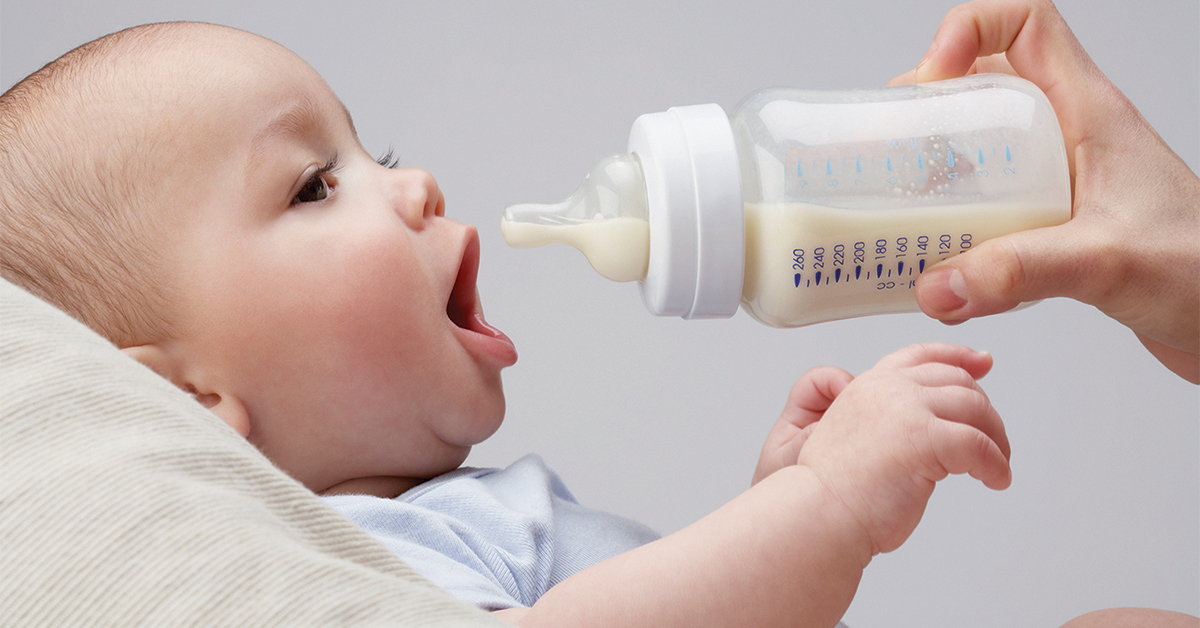
Bottle-feeding also benefits from careful alignment and responsive pacing. Hold your baby close and keep the head higher than the stomach. The baby should be supported in a semi-upright position, not flat on the back.
A safe bottle-feeding setup includes:
• Supporting the baby’s head and neck
• Keeping the baby’s head in line with the body
• Holding the bottle at a gentle angle
• Allowing pauses during the feed
• Watching for signs of stress or fullness
Paced bottle-feeding can help the baby control the flow. Hold the bottle more horizontally so milk does not rush into the mouth. Give the baby time to pause, breathe, and decide whether to continue.
Avoid propping a bottle against a pillow or leaving it in the baby’s mouth. Bottle propping increases the risk of choking, ear infections, tooth decay, and overfeeding. It also removes the close contact that helps you notice changes in breathing or comfort.
A common mistake is trying to make a baby finish the entire bottle. Newborns have small stomachs and different needs at each feed. Follow hunger and fullness cues rather than forcing the last ounce.

How to Support a Good Latch
A good latch allows the baby to take in milk with less pain and less effort. Position is the first step, but timing matters too. Try to begin when your baby shows early hunger cues.
Early cues may include:
• Stirring or waking
• Turning the head from side to side
• Bringing hands to the mouth
• Opening the mouth
• Making small sucking sounds
Crying is a late hunger cue. A crying baby may need calming before attempting to latch. Hold the baby close, speak softly, and try skin-to-skin contact.
For breastfeeding, brush the nipple across the baby’s upper lip. Wait for a wide-open mouth. Then bring the baby to the breast, aiming the nipple toward the roof of the mouth.
Signs of a deeper latch may include:
• More areola above the baby’s upper lip than below the lower lip
• Rounded cheeks
• Slow, deep sucks
• Audible swallowing
• Little or no pinching pain
Some tenderness can occur during the first days, but severe or ongoing pain deserves help. A lactation consultant can watch a full feed and suggest small changes to position, latch, or support.

Feeding Cues and Responsive Feeding
Responsive feeding means noticing what your baby communicates and responding with care. It does not mean feeding on demand without observing patterns. It means using hunger and fullness cues along with guidance from your baby’s health care provider.
Hunger cues can include:
• Hands moving toward the mouth
• Lip smacking
• Rooting
• Increased alertness
• Sucking on fingers
Fullness or pause cues can include:
• Turning away
• Relaxing the hands
• Slowing or stopping sucking
• Falling asleep after active feeding
• Pushing the nipple out
Newborn feeding position principles work best when paired with responsive feeding. A baby may need a pause, a burp, a diaper change, or a short cuddle. Not every pause means the feed is finished, and not every cry means the baby is hungry.
Many parents worry about feeding times. Timing can be useful, but it should not replace observing the baby. Newborn feeding patterns vary. Your pediatrician can help you assess intake through weight gain, diaper output, and feeding behavior.

Burping and Managing Swallowed Air
Some babies swallow air during feeding. A calm position may reduce this, but burping needs differ from baby to baby. Breastfed babies may swallow less air in some feeds, while bottle-fed babies may swallow more, especially when the flow is fast.
You can try burping when your baby pauses, changes rhythm, or seems uncomfortable. Keep the baby upright and support the head and neck.
Common burping positions include:
• Holding the baby upright against your chest
• Sitting the baby on your lap with the chest supported
• Placing the baby across your lap with the head higher than the chest
Use gentle pats or rubs. Hard tapping is not needed. If the baby is comfortable and does not burp, there is no need to keep trying for a long time.
For babies who spit up, keep the baby upright for a short period after feeding while staying awake and alert. Always place the baby on the back in a separate sleep space for sleep, even when reflux is present, unless a medical professional gives different instructions for a specific medical reason.
Common Positioning Mistakes to Avoid
Small changes can make a large difference. These are common mistakes that parents can correct with simple adjustments.
• Holding the baby too far from the body: Bring the baby close so the baby does not pull on the nipple or bend the neck.
• Turning only the head: Move the baby’s whole body toward the breast or bottle.
• Pressing the back of the head: Support the neck and shoulders instead. Pressure on the head may make the baby push away.
• Covering the nose: Keep the breast or bottle from pressing against the nose.
• Feeding while lying flat: Use a supported, semi-upright position for bottle-feeding.
• Ignoring stress signals: Pause if the baby coughs, gulps, turns red, or pulls away.
• Focusing only on the clock: Watch active sucking, swallowing, and fullness cues.
• Using too many pillows: Pillows may shift and create unsafe gaps. Use stable support and keep the baby’s airway visible.
A lesson many new parents learn is that comfort matters for both people. If your shoulders are tense and your back hurts, your baby may also become unsettled. Support your arms, relax your jaw, and take a slow breath before starting.

When to Seek Feeding Support
Most feeding problems improve with early guidance. Contact your baby’s pediatrician, lactation consultant, or feeding specialist if feeding remains painful, stressful, or unusually tiring.
Seek professional advice if your baby:
• Coughs or chokes during many feeds
• Has blue or gray coloring around the lips
• Breathes rapidly or struggles to breathe
• Is difficult to wake for feeds
• Has fewer wet diapers than expected
• Does not regain birth weight as expected
• Feeds for very long periods but still seems hungry
• Repeatedly vomits forcefully
• Has persistent noisy breathing during feeds
Get urgent medical help for breathing trouble, blue coloring, severe weakness, or poor responsiveness.
A health professional may assess latch, milk transfer, oral movement, muscle tone, reflux symptoms, and weight gain. Premature babies and babies with medical conditions may need a special feeding plan, such as a different nipple flow, side-lying bottle-feeding, or scheduled pauses.
A Simple Newborn Feeding Position Checklist
Use this checklist before and during a feed:
-
Wash your hands and settle into a supported position.
-
Bring your baby close, with the chest facing your chest.
-
Check that the ear, shoulder, and hip are aligned.
-
Keep the head slightly free to move and the nose clear.
-
Watch for early hunger cues.
-
Support the baby’s body without pressing on the back of the head.
-
Look for smooth sucking, swallowing, and breathing.
-
Pause when the baby shows stress or fullness cues.
-
Burp gently if the baby seems uncomfortable.
-
Place the baby on the back in a separate, safe sleep space after feeding.
This newborn feeding position principles checklist is not a substitute for medical care. It is a practical reminder that helps you create a steady, safe starting point.
Frequently Asked Questions About Newborn Feeding Position Principles
What is the best position for feeding a newborn?
The best position keeps your baby close, supported, and aligned, with the head, neck, and body in one line. For breastfeeding, cross-cradle and laid-back positions often give good support, while semi-upright paced feeding works well for bottles.
Should a newborn lie flat during bottle-feeding?
No. Hold a newborn in a semi-upright position with the head higher than the stomach. Keep the bottle angled gently and never prop it in the baby’s mouth.
How do I know if my baby’s feeding position is correct?
Your baby should breathe comfortably, keep rounded cheeks, and show steady sucking with pauses. The baby’s chest should face your body, and the head should not be sharply turned or pressed forward.
Can feeding position help with newborn reflux?
An upright or semi-upright position during feeding may reduce discomfort for some babies, but it does not cure reflux. Keep the baby upright while awake after feeding and always place the baby on the back for sleep.
Should I wake my newborn to feed?
Some newborns need to be awakened for feeds, especially if they are premature, have low blood sugar risk, or have not regained birth weight. Follow the feeding plan from your pediatrician rather than relying on a general schedule.
Is side-lying breastfeeding safe?
Side-lying breastfeeding can be used when you are awake and supervising the feed. Move the baby to a separate, firm, flat sleep space on the back before you sleep.
When should I ask for help with breastfeeding position?
Ask for help if you have ongoing nipple pain, your baby cannot latch, feeds are extremely long, or your baby is not gaining weight well. Early support can prevent small positioning issues from becoming larger feeding problems.
Conclusion
Newborn feeding position principles center on alignment, support, comfort, clear airways, and responsive care. Keep your baby’s head, neck, and body in one line, hold the baby close, watch feeding cues, and allow regular pauses for breathing and rest.
There is no single position that fits every baby or every family. Try small changes, observe your baby’s response, and seek help early when feeding is painful, tiring, or unsafe. Use this guide at your next feed, discuss concerns with your pediatrician or lactation consultant, and explore trusted newborn-feeding resources for continued support.