Newborn developmental surveillance tracks early growth, behavior, and skills so concerns can be found and supported early.
The newborn period is brief, but it offers valuable clues about a baby’s health and development. Newborn developmental surveillance is an ongoing process that combines medical visits, caregiver observations, physical exams, and milestone discussions. It is not a one-time test or a pass-or-fail grade.
This guide explains what newborn developmental surveillance includes, how it differs from developmental screening, what clinicians look for, and how parents can take part with confidence. It also covers preterm babies, warning signs, practical questions, and trusted guidance used in pediatric care.
What Is Newborn Developmental Surveillance?
Newborn developmental surveillance is the regular process of watching, recording, and discussing a baby’s development over time. It begins soon after birth and continues during well-child visits.
A pediatric clinician may observe how a newborn:
• Moves the arms and legs
• Responds to sound and light
• Feeds and swallows
• Calms with touch or a familiar voice
• Looks at faces
• Uses different cries
• Maintains muscle tone and posture
• Reacts during a physical exam
The word “surveillance” does not mean watching a baby in a fearful way. It means staying alert to patterns. One quiet day rarely tells the full story, just as one cloudy morning does not predict the whole season.
Newborn developmental surveillance also includes information from parents and caregivers. You may notice changes that do not happen during a short office visit. For example, you may see that your baby turns toward your voice at home but becomes too tired to respond during an appointment.

Why Newborn Developmental Surveillance Matters
Early development affects feeding, movement, communication, learning, and social connection. When a concern is found early, a care team can assess it and offer support before the issue affects more areas of development.
Newborn developmental surveillance may help identify:
• Hearing or vision concerns
• Feeding and swallowing problems
• Weak or unusually stiff muscle tone
• Delayed motor responses
• Trouble gaining weight
• Effects linked to premature birth
• Signs of infection, illness, or neurologic problems
• A need for early intervention services
The goal is not to label a baby too soon. The goal is to understand the baby’s needs and act when support may help.
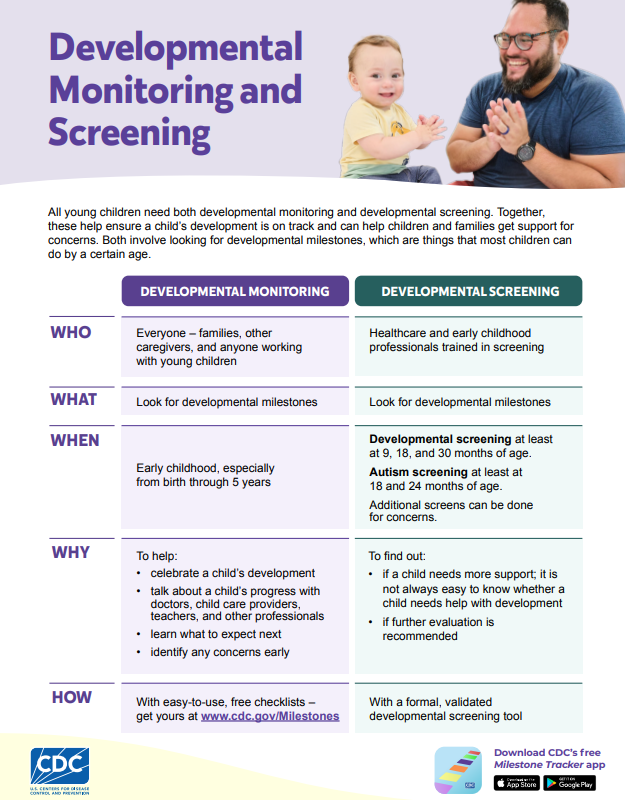
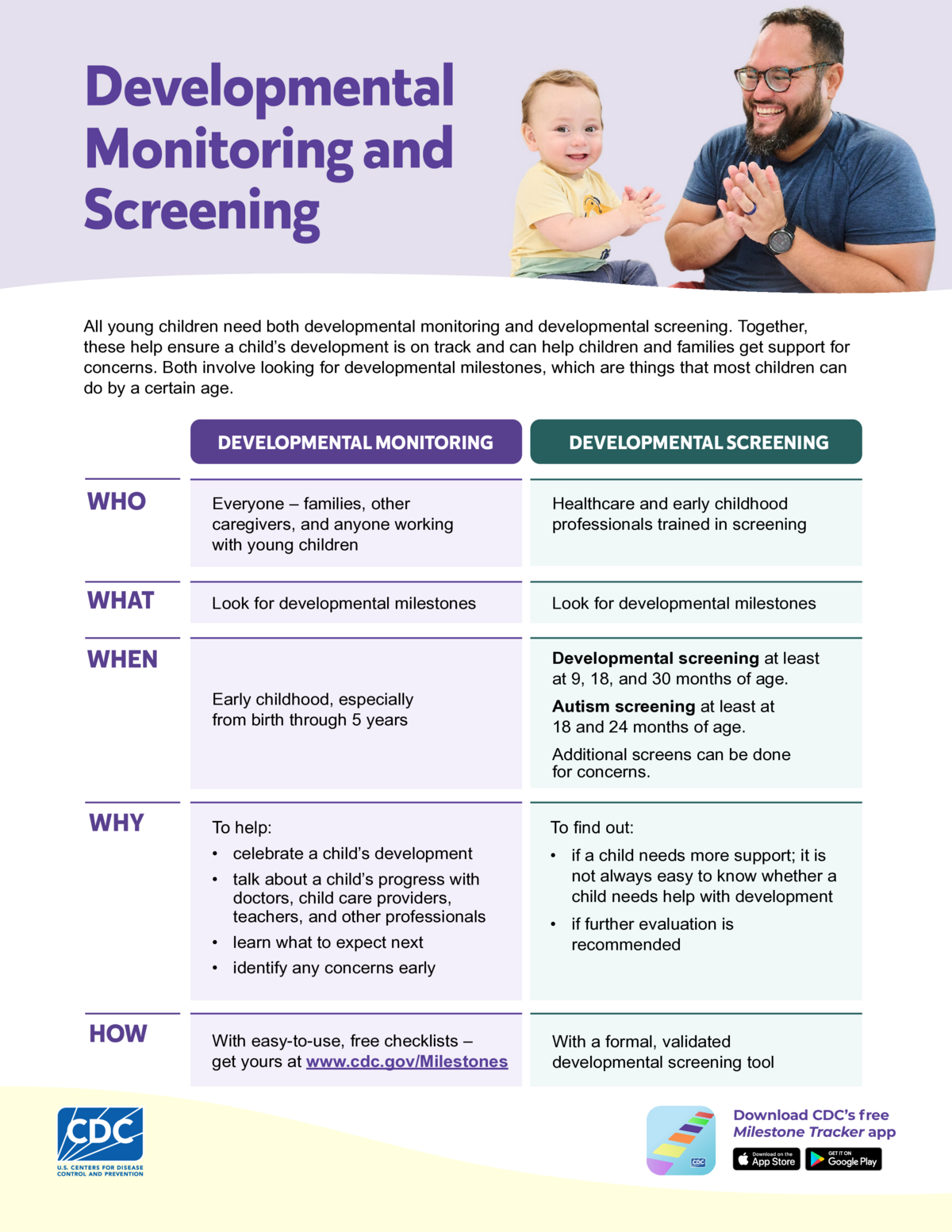
The American Academy of Pediatrics recommends developmental surveillance at routine well-child visits. It also recommends formal developmental screening at specific ages, such as 9, 18, and 30 months, unless a clinician has a reason to screen sooner. Autism-specific screening is commonly recommended at 18 and 24 months.
These later screenings do not replace newborn developmental surveillance. Instead, they work together. Surveillance is the ongoing conversation, while screening is a more structured check at a set time.
How Newborn Developmental Surveillance Works
A newborn visit usually includes more than a physical exam. The clinician gathers information from several sources to form a clear picture of the baby.
1. Reviewing pregnancy and birth history
The clinician may ask about:
• Premature birth
• Birth weight
• Complications during labor
• Low oxygen levels
• Infections
• Newborn intensive care treatment
• Exposure to medicines or substances
• Family history of hearing, vision, genetic, or neurologic conditions
This history helps the clinician understand risk. A risk factor does not mean a baby will have a developmental problem. It simply shows where closer follow-up may be useful.
2. Watching movement and muscle tone
Newborns often keep their arms and legs bent. They may move in sudden bursts and then rest. Clinicians look for symmetry, strength, posture, and the quality of movement.
They may observe whether:
• Both sides of the body move in a similar way
• The baby moves all four limbs
• The arms or legs seem very floppy
• The body feels unusually stiff
• The baby favors one side
• Movements look smooth or repeated in an unusual pattern
A single unusual movement may have a simple cause, such as hunger, cold, or fatigue. Repeated or persistent patterns deserve medical review.
3. Checking newborn reflexes
Newborn reflexes are automatic actions linked to early brain and nerve function. Common reflexes include:
• Rooting, when a baby turns toward a touch near the mouth
• Sucking, which supports feeding
• Moro, or the startle response
• Grasping of a finger
• Stepping movements when held upright
Reflexes change as the nervous system matures. A clinician considers the baby’s age, birth history, alertness, and overall exam. Reflexes alone cannot predict a child’s future development.
4. Discussing feeding and sleep
Feeding is a major part of newborn developmental surveillance. The clinician may ask how long feeds take, whether the baby coughs or chokes, and how often the baby has wet diapers.
Sleep questions may include:
• How often the baby wakes
• Whether the baby is difficult to wake for feeds
• Whether the baby stays awake for long periods
• How the baby settles after waking
Newborn sleep varies greatly. Still, extreme sleepiness, poor feeding, or a sudden change in behavior needs prompt attention.
5. Asking caregivers what they notice
Parents are important observers. You do not need medical training to share useful information.
Try to describe:
• What you saw
• When it began
• How often it happens
• What makes it better or worse
• Whether it affects feeding, sleep, or comfort
Short videos can help when a movement happens only at home. Ask the clinician before recording in a medical setting, and never delay urgent care to make a video.

Newborn Developmental Surveillance Versus Developmental Screening
These terms are related, but they are not the same.
Newborn developmental surveillance is:
• Ongoing
• Flexible
• Based on observation and discussion
• Included in routine care
• Shaped by family concerns and medical history
Developmental screening is:
• More formal
• Based on a standard tool
• Completed at a specific age or when a concern arises
• Designed to identify children who may need further assessment
A screening result is not a diagnosis. It shows whether a baby may benefit from a closer evaluation.
For newborns, clinicians may use observation, physical exams, feeding assessments, hearing tests, and other tools. A formal developmental questionnaire is often more useful later, when babies have a wider range of clear skills.
This difference prevents a common mistake: treating a normal newborn exam as proof that future development will be typical. Development changes over time, so follow-up remains important.
What Developmental Skills Are Expected in a Newborn?
Newborn abilities vary. A baby born at 39 weeks may behave differently from a baby born at 35 weeks. Even full-term babies have different temperaments and energy levels.
Many healthy newborns can:
• Briefly focus on a face
• Startle at a loud sound
• Calm when held or spoken to
• Move both arms and legs
• Make small sounds besides crying
• Suck and swallow during feeds
• Turn the head toward a touch near the mouth
• Flex the arms and legs
• Respond to light or changes in position
Newborns do not usually smile socially, sit, babble, or reach with purpose. Those skills come later. Comparing a newborn with an older sibling, a neighbor’s baby, or online videos can create needless worry.
The Centers for Disease Control and Prevention provides milestone guidance for later ages. These milestones help families know what to watch for, but they are not a substitute for an individual medical evaluation.
Developmental Surveillance for Premature Babies
Premature babies often follow a different developmental timeline. Clinicians may use corrected age when reviewing development.
Corrected age is calculated by subtracting the number of weeks a baby was born early from the baby’s actual age. For example, a baby who is 8 weeks old but was born 4 weeks early may be considered 4 weeks corrected age for developmental expectations.
Corrected age is often used until about 2 years, although the exact plan may vary. The care team may also consider birth weight, medical problems, time in intensive care, and current health.
Parents of premature babies should ask:
• Which age should we use for milestones?
• How often should development be checked?
• Does our baby need physical, occupational, or feeding therapy?
• Are there early intervention services in our area?
• When should hearing and vision be repeated?
Newborn developmental surveillance is especially helpful for premature babies because progress may not follow a simple calendar. The important question is often whether skills are emerging and improving over time.

Warning Signs That Need Medical Attention
A newborn may have an off day. Still, certain signs should be discussed with a pediatric clinician promptly.
Contact a health professional if your newborn:
• Does not feed well or repeatedly refuses feeds
• Chokes, coughs, or turns blue during feeds
• Is very difficult to wake
• Has weak movement on one side
• Does not move one arm or leg
• Seems extremely floppy or unusually stiff
• Has repeated shaking or jerking that does not stop when gently held
• Does not respond to loud sounds
• Has trouble breathing
• Has a fever, especially during the first weeks of life
• Loses a skill or behavior that was present before
Call emergency services for severe breathing trouble, blue or gray skin, unresponsiveness, or a seizure-like event. When in doubt, seek help. It is better to have a concern checked than to wait and feel uncertain.
A parent’s concern matters even when the newborn developmental surveillance visit appears normal. Tell the clinician what worries you and ask what signs should lead to a follow-up visit.

How Parents Can Support Development at Home
Simple daily care supports early development. Newborns do not need expensive toys or complex programs. They need safe, warm, responsive relationships.
Try these practices:
• Talk, sing, and read to your baby
• Hold your baby during calm, awake periods
• Make gentle eye contact
• Respond to cries with comfort
• Give supervised tummy time when your baby is awake
• Let your baby rest when tired
• Keep screens away from the baby
• Follow safe sleep guidance
Tummy time helps build strength, but always place a baby on the back for sleep. Start with short periods while awake and supervised. A baby may tolerate tummy time better on your chest or across your lap.
Responsive care works like a conversation. Your baby makes a sound, looks away, or moves a hand. You respond with your voice, touch, or a pause. These small exchanges help build trust and early communication.
Preparing for a Newborn Developmental Surveillance Visit
A little preparation can make the visit more useful. New parents are tired, and it is easy to forget details after a long night.
Before the appointment:
-
Write down feeding times and concerns.
-
Note wet and dirty diaper patterns.
-
Record unusual movements, if safe to do so.
-
Bring discharge papers and newborn screening results.
-
List medicines, vitamins, and supplements.
-
Write down family health concerns.
-
Ask another caregiver to join if possible.
Useful questions include:
• Is my baby’s movement symmetrical?
• Does my baby’s muscle tone look typical?
• Are feeding and weight gain on track?
• Does my baby need another hearing or vision check?
• Should we use corrected age?
• When should we return for follow-up?
• What should we do if the same concern happens at home?
One practical lesson from newborn care is that vague descriptions can slow communication. Instead of saying, “Something seems wrong,” try, “My baby has started turning the head only to the right during feeds.” Clear details help the clinician decide what to do next.
Benefits and Limits of Newborn Developmental Surveillance
Newborn developmental surveillance has several benefits:
• It can detect concerns early.
• It includes the caregiver’s observations.
• It builds a record across visits.
• It supports timely referrals.
• It encourages questions and shared decisions.
• It can reassure families when development appears on track.
However, surveillance has limits. Newborn behavior changes with hunger, tiredness, illness, room temperature, and stress. A short office visit may not show everything a baby does at home.
Surveillance also cannot predict every future learning, behavior, or communication outcome. Some developmental differences become clear only as a child grows. This is why regular visits and repeated observation matter.
A normal finding today is helpful, but it is not a guarantee. A concern today is also not a final diagnosis. Think of surveillance as a map that is updated as the journey continues.
When a Referral or Further Evaluation Is Needed
A pediatric clinician may recommend more assessment when a concern persists or when a baby has a higher risk of developmental difficulty.
Possible referrals include:
• Audiology for hearing evaluation
• Ophthalmology for vision assessment
• Physical therapy for movement or tone concerns
• Occupational therapy for feeding or motor skills
• Speech and feeding therapy for swallowing concerns
• Neurology for unusual movements or muscle tone
• Genetics for a pattern of medical or developmental findings
• Early intervention for developmental support
Early intervention programs vary by state. In the United States, families can often contact their state or local program directly for an evaluation. Services may be available even before a firm diagnosis is made.
Do not assume a referral means something terrible has been found. Often, it means the clinician wants another expert to answer a focused question.
Evidence-Based Guidance for Newborn Developmental Surveillance
Reliable care uses more than one source of information. Pediatric clinicians commonly combine medical history, caregiver reports, physical examination, developmental observation, newborn screening results, and follow-up data.
Major guidance supports:
• Routine developmental surveillance during well-child care
• Standardized developmental screening at recommended ages
• Autism screening at recommended ages
• Prompt evaluation when a caregiver or clinician has a concern
• Early support for children who qualify
The American Academy of Pediatrics Bright Futures guidance provides a framework for preventive pediatric visits. State newborn screening programs commonly check for selected metabolic, genetic, endocrine, and other conditions. Newborn hearing screening is also a key part of early detection.
Testing programs differ by state and hospital. Ask your baby’s care team which tests were completed and whether any repeat testing is needed.
Frequently Asked Questions About Newborn Developmental Surveillance
What is the purpose of newborn developmental surveillance?
Its purpose is to track a baby’s early development and identify concerns as soon as possible. It also gives parents a regular chance to ask questions and receive guidance.
When does newborn developmental surveillance begin?
It begins at birth or during the first newborn examination. It continues through follow-up visits, where clinicians review feeding, movement, behavior, growth, and caregiver concerns.
Is newborn developmental surveillance the same as a developmental screening test?
No. Surveillance is an ongoing process based on observation and discussion, while screening uses a more structured tool at a specific age or when concerns arise.
Can a newborn have delayed development?
Newborn development is highly variable, and many early behaviors are still emerging. A clinician looks for patterns, risk factors, and changes over time instead of judging development from one behavior alone.
What should I do if I am worried about my newborn?
Contact your pediatric clinician and describe what you see, when it happens, and how often it occurs. Seek emergency care for serious breathing trouble, blue or gray skin, unresponsiveness, or seizure-like activity.
Do premature babies need special developmental follow-up?
Many premature babies benefit from closer follow-up and corrected-age milestone guidance. Their care team may recommend additional hearing, vision, feeding, movement, or early intervention assessments.
Can newborn developmental surveillance diagnose autism?
No. Newborn developmental surveillance cannot diagnose autism. Autism-specific screening is generally done later, often at 18 and 24 months, although concerns can be assessed at any age.
Conclusion
Newborn developmental surveillance is a steady way to understand how a baby feeds, moves, responds, and grows. It combines clinical observation with the knowledge parents gain from daily care. It is different from formal screening, and it cannot predict every future outcome, but it can help identify concerns early.
Attend routine visits, share specific observations, follow up on referrals, and trust yourself when something feels unusual. Keep a simple record of questions and changes, and ask your baby’s clinician to explain any result in plain language.
Your attention is part of your baby’s care. Use newborn developmental surveillance as a partnership with your health team, and explore trusted pediatric resources for the next stage of your child’s growth.


