Newborns see best up close and begin with brief, jerky tracking before smooth eye movement develops.
Newborn visual tracking development is a gradual process, not a test your baby must pass on a strict schedule. As a child health writer who follows pediatric vision guidance, I know parents often worry when a baby looks away, crosses their eyes, or seems slow to follow a face. This guide explains what to expect, how to support healthy visual development, and when to ask a pediatrician or eye doctor for help.

What Is Newborn Visual Tracking Development?
Newborn visual tracking development is the process of learning to follow a moving person, toy, or light with the eyes. It depends on several skills working together, including clear vision, eye movement, focus, attention, and brain development.
A newborn does not usually track objects in a smooth line. In the first weeks, your baby may glance at a face, lose focus, and then look again. This stop-and-start pattern is often normal because the eye muscles and visual brain pathways are still maturing.
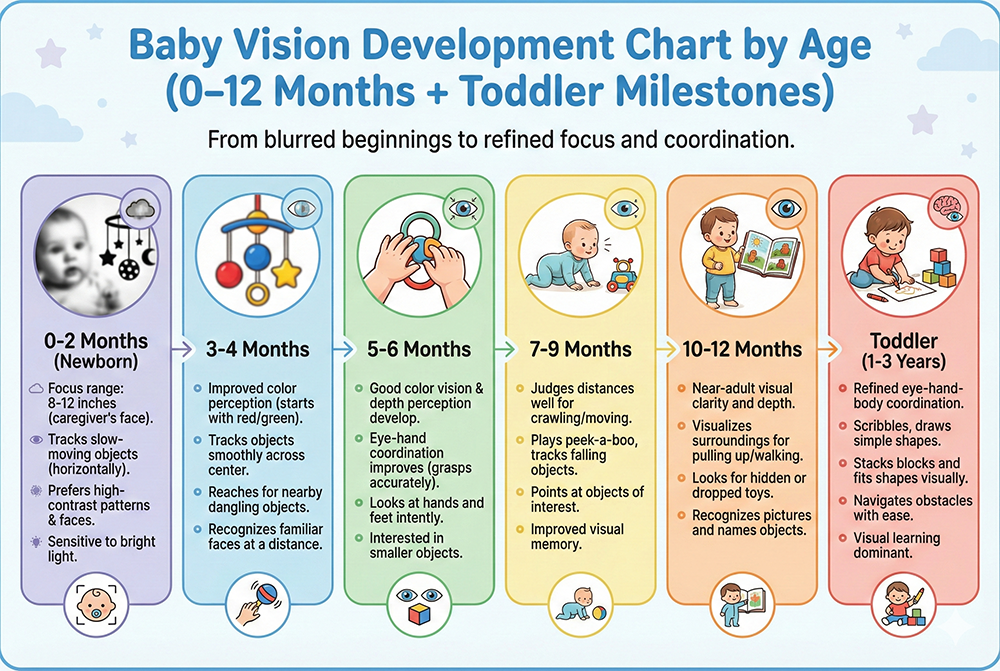
Newborns tend to see best at about 8 to 12 inches from their face. This is roughly the distance between a baby and a parent during feeding. Faces, bold patterns, and strong light-dark contrast are often easier to notice than small, colorful toys.
Newborn visual tracking development is closely linked with early bonding. Your baby may study your face during a quiet feed or watch your mouth as you speak. These small moments help build attention, visual focus, and social connection.

Newborn Visual Tracking Milestones by Age
Every baby develops at a slightly different pace. Milestones offer a helpful guide, but they are not a rigid checklist. Premature babies may reach some visual milestones later when measured by their corrected age.
Birth to 1 month
During the first month, babies may:
• Briefly look at faces, lights, or high-contrast shapes
• Prefer objects close to the face
• Focus for only a few seconds
• Move the eyes without moving the head
• Show occasional eye crossing or wandering
• Startle or blink when exposed to bright light
At this stage, newborn visual tracking development is limited. Your baby may not follow a toy across the room. That is expected because distance vision and eye control are still developing.
Around 2 months
by about 2 months, many babies begin to:
• Watch a face for longer periods
• Follow a slow-moving object from side to side
• Look at their caregiver during feeding
• Shift their gaze between nearby objects
• Smile or vocalize when they see a familiar face
Tracking may still be uneven. Your baby might follow a toy halfway and then stop. Try again later when your baby is calm and alert.
Around 3 to 4 months
At this age, babies often show clearer progress in newborn visual tracking development. They may:
• Track objects across a wider area
• Watch moving hands and toys
• Look at their own fingers
• Reach toward an interesting object
• Turn the head to keep a toy in view
Eye and hand coordination also begins to improve. A baby may look at a rattle, reach for it, and miss. That missed grab is part of normal learning.
Around 5 to 6 months
By 5 or 6 months, many babies can:
• Follow objects in several directions
• Watch people move around a room
• Look from a nearby toy to a caregiver’s face
• Reach for objects with better accuracy
• Notice smaller details and more colors
• Use both eyes together more steadily
These changes do not happen overnight. Visual development grows through repeated daily experiences, such as looking at faces, watching a caregiver walk by, and reaching for safe toys.

How Vision Develops in the First Year
Newborn visual tracking development begins with simple light and shape awareness. It then grows into steady focus, smooth tracking, depth awareness, and hand-eye coordination.
In the early weeks, the brain receives basic visual signals. Over time, it learns to combine information from both eyes. This process helps a baby understand where an object is and how far away it may be.
A useful way to picture this is to imagine a camera coming into focus. At first, the image may be blurry and brief. With practice, the picture becomes clearer, steadier, and easier to follow.
Important parts of early visual development include:
• Visual fixation: Holding the eyes on one person or object
• Smooth pursuit: Following a moving object with the eyes
• Saccades: Shifting the gaze from one object to another
• Binocular vision: Using both eyes together
• Depth perception: Judging space and distance
• Visual attention: Staying focused on something interesting
Tracking is only one part of vision. A baby may see an object but not yet have the eye control needed to follow it smoothly. This is why parents should look at overall progress rather than one brief observation.

Signs of Typical Newborn Visual Tracking
Normal newborn visual tracking development can look subtle. Parents sometimes expect a baby to follow a toy like an older child, but newborns often show progress through small changes.
Typical signs may include:
• Looking toward a parent’s face
• Briefly following a slow-moving face
• Becoming more alert when a caregiver comes close
• Watching a high-contrast toy
• Turning the head toward movement
• Looking at hands during quiet play
• Refocusing after looking away
Your baby may track better in the morning, after a nap, or during a calm period. Hunger, tiredness, illness, bright light, and noise can all reduce visual attention.
One practical lesson is to observe patterns, not single moments. A baby who does not follow a toy while crying may track it well later after feeding. Testing too often can also make the experience stressful for both of you.
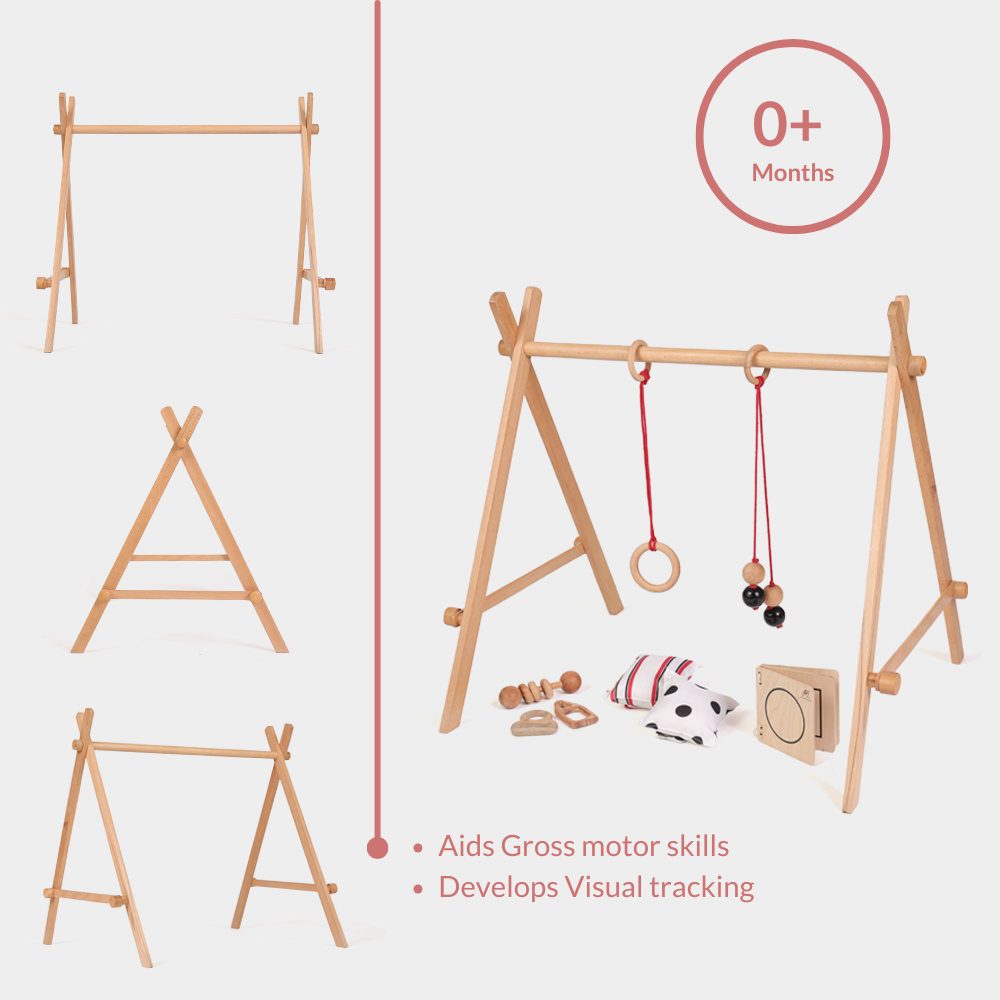
Simple Activities to Support Visual Tracking
You do not need special equipment to support newborn visual tracking development. Your face, voice, and gentle movement are often the best tools.
1. Use face-to-face time
Hold your baby close during feeding, cuddling, or talking. Move your face slowly from one side to the other and pause when your baby looks at you.
2. Choose high-contrast objects
Black-and-white cards, bold stripes, and simple shapes may be easier for a young baby to notice. Hold the object about 8 to 12 inches away.
3. Move toys slowly
Move one safe toy from side to side at a gentle pace. Give your baby time to look before moving it again. Fast movement can be too hard to follow.
4. Use natural daily routines
Let your baby watch you fold laundry, walk across the room, or bring a bottle. Everyday movement offers useful visual practice without turning play into a lesson.
5. Follow your baby’s cues
Stop when your baby turns away, fusses, yawns, or closes the eyes. Looking away often means the baby needs a break, not that something is wrong.
6. Offer tummy time when awake
Supervised tummy time supports head control, which later helps visual tracking. Begin with short sessions and follow your pediatrician’s guidance, especially if your baby was premature or has medical needs.
7. Keep the environment calm
Soft, even lighting and limited background noise can help a baby focus. Too many toys, flashing lights, or loud sounds may compete for attention.
The most common mistake is moving a toy too quickly. Slow movement gives the brain time to notice, focus, and follow. Another mistake is placing the object too far away, where newborn vision may not yet be clear.

What Can Affect Newborn Visual Tracking?
Many factors can influence how a baby tracks objects. Some are temporary, while others may need medical attention.
Premature birth
Babies born early may reach vision milestones later. Health professionals often use corrected age during the first two years. Ask your child’s doctor how to measure progress if your baby was premature.
Tiredness or hunger
A tired or hungry baby may not look at toys or faces. Try visual activities after feeding and sleep, when the baby is calm and alert.
Bright or dim lighting
Very bright light can cause squinting or turning away. Very low light can make it harder to see. Use comfortable, even room light.
Eye alignment changes
Brief eye crossing or wandering can happen in young babies. The eyes often become more coordinated over the first few months. Persistent misalignment deserves a professional check.
Refractive errors
Nearsightedness, farsightedness, or astigmatism can affect clear vision. These conditions may not be obvious to a parent because a baby cannot describe blurry vision.
Eye or brain conditions
Less common causes include cataracts, retinal disorders, optic nerve problems, and conditions that affect visual processing. Early assessment matters because the developing visual system responds best to timely care.
A parent cannot diagnose the cause by watching tracking at home. Home observations are useful information, but they do not replace a medical eye examination.

When to Call a Pediatrician or Eye Doctor
Contact your baby’s pediatrician if you notice concerns about newborn visual tracking development. Ask for guidance rather than waiting if a concern feels persistent or unusual.
Seek medical advice if your baby:
• Does not seem to notice light or faces
• Does not make brief eye contact by about 2 months
• Does not appear to follow a nearby object by about 3 months
• Has one eye that constantly turns in or out
• Has eyes that shake or move rapidly
• Has a white or gray-looking pupil in photographs or normal light
• Keeps one eye closed in ordinary indoor light
• Has excessive tearing, redness, swelling, or discharge
• Shows a sudden change in visual behavior
• Uses one eye much more than the other
A white pupil can be a serious warning sign and should be checked promptly. It may sometimes appear in photographs because of lighting, but repeated unusual reflections need professional review.
Regular well-child visits are a good time to discuss vision. In the United States, routine vision screening becomes more detailed as children grow. Newborns also receive basic eye checks, but screening cannot detect every possible condition.
Trust your observations. Parents often notice small changes before anyone else. Write down what you see, including the baby’s age, the distance of the object, lighting, and whether the behavior happens in one or both eyes.
Newborn Visual Tracking and Screen Use
Screens are not needed for newborn visual tracking development. A phone or tablet may attract a baby’s attention, but it does not offer the same value as face-to-face interaction and real-world movement.
The American Academy of Pediatrics advises avoiding routine screen media for children younger than 18 months, except for video calls. Video calls with family can support social connection when an adult stays involved.
Instead of using a screen, try:
• Talking face to face
• Singing softly
• Showing a simple picture book
• Moving a safe toy slowly
• Letting your baby watch family activities
• Taking short, supervised tummy-time breaks
Screens can also make it harder for adults to notice a baby’s tired cues. A real face has changing expressions, voice, movement, and emotional meaning. Those features support more than vision alone.

How to Track Progress Without Creating Stress
Parents often want to know whether their baby is “on track.” A simple observation routine can help without turning play into a test.
Try these steps:
-
Choose a calm time after your baby has rested and fed.
-
Sit in comfortable, even light.
-
Hold your face or a simple toy about 8 to 12 inches away.
-
Wait for your baby to notice it.
-
Move slowly to one side.
-
Pause and watch for eye or head movement.
-
Stop if your baby looks away or becomes upset.
-
Repeat on another day rather than testing many times.
Keep a short note if you see a concern. Include the date and what happened. A brief video may also help a clinician, but never delay care while trying to record the behavior.
The goal is not perfect performance. The goal is gradual growth in attention, focus, and coordination. Newborn visual tracking development is more like learning a song than passing an exam; each small attempt adds to the pattern.
Common Myths About Infant Eye Tracking
Myth: A newborn should follow every toy
Newborns have limited focus and attention. Brief, uneven tracking is common during the first weeks.
Myth: Eye crossing always means a serious problem
Temporary eye crossing can occur in early infancy. Constant crossing, worsening alignment, or an eye that always turns should be assessed.
Myth: Colorful toys work best for newborns
High-contrast shapes may be easier for young babies to notice than complex, colorful designs. Color vision develops during infancy, but newborns can still respond to some color and light differences.
Myth: More visual stimulation is always better
Too much stimulation can overwhelm a baby. Short, calm periods with one face or toy are often more helpful than a busy room full of lights and sounds.
Myth: Parents can confirm healthy vision at home
Home observation can show useful behavior, but it cannot rule out eye disease or vision loss. Professional screening remains important.
Frequently Asked Questions About Newborn Visual Tracking Development
When do newborns start tracking objects?
Many newborns briefly look at faces and nearby objects from birth. More consistent side-to-side tracking often develops around 2 to 3 months.
How far can a newborn see?
Newborns usually see best at about 8 to 12 inches from their face. Vision beyond that range may look less clear during the early weeks.
Is it normal for a newborn’s eyes to cross?
Brief eye crossing or wandering can be normal in early infancy while eye control develops. Constant misalignment or an eye that repeatedly turns in one direction should be checked by a healthcare professional.
What is the best toy for newborn visual tracking?
A parent’s face is often the best first “toy.” Simple, high-contrast objects held close and moved slowly can also support early visual attention.
When should a baby follow a toy smoothly?
Smooth tracking often improves between 2 and 4 months. Development varies, but a baby who does not seem to notice faces or nearby objects should be discussed with a pediatrician.
Can premature babies develop visual tracking later?
Yes. Premature babies may reach visual milestones later when judged by their corrected age. Their pediatrician can explain what timing is expected based on birth age and medical history.
Do screens improve newborn vision?
No. Screens are not needed to support newborn visual tracking development. Face-to-face play, natural movement, and safe real-world objects offer more useful early experiences.
Conclusion
Newborn visual tracking development begins with brief looks and grows into steadier focus, smooth eye movement, and better hand-eye coordination. Most babies develop these skills gradually, with wide variation in timing.
Support your baby with close face-to-face contact, slow toy movement, high-contrast objects, good lighting, and plenty of rest. Watch for persistent concerns, sudden changes, unusual eye movements, or signs that your baby does not notice light and faces.
You know your baby best. Share observations at well-child visits, seek advice when needed, and keep learning about healthy infant vision through trusted pediatric resources.