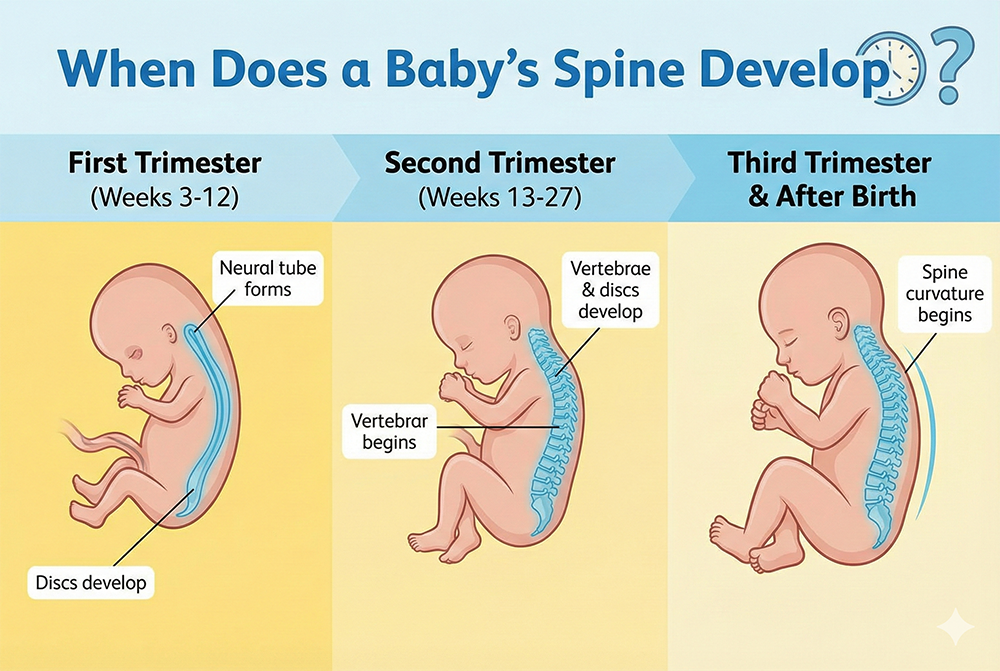
A newborn’s spine starts in a gentle C shape and slowly develops stronger curves as movement skills grow.
Newborn spine and posture development is a gradual process shaped by muscle strength, movement, sleep position, and daily care. A baby’s back may look rounded at first, and that is usually normal. This guide explains what to expect, how to support healthy movement, and which signs need medical advice.
What newborn spine and posture development looks like
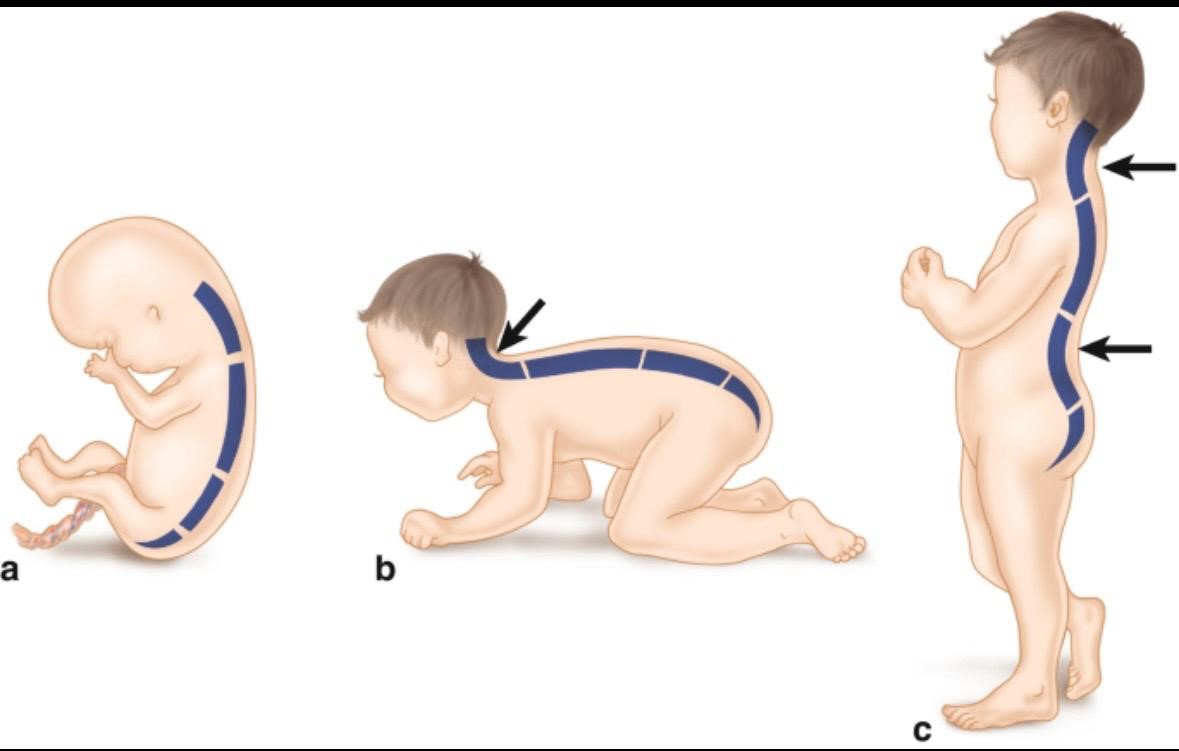
A newborn’s spine is not straight like an adult spine. It has one gentle curve, often called a C shape. This curve helps a young baby curl, rest, and feel secure after months in the womb.
Newborn spine and posture development follows the growth of the nervous system, bones, muscles, and balance. Babies do not yet have the trunk strength needed to hold their head or sit upright.
A newborn may naturally:
• Keep the arms and legs bent
• Turn the head to one side
• Round the back when held
• Pull the knees toward the belly
• Make small, uneven movements
• Need full head and neck support
These actions are part of normal early posture. They are not signs that a baby has poor posture.
As the baby grows, the spine changes through movement. Head control comes first. Later, the baby rolls, sits, crawls, stands, and walks. Each skill helps build the next stage of balance and body control.
Think of the spine as a young tree. It needs time, steady care, and room to grow. It should not be forced into a mature shape too soon.

How the infant spine develops over time
Newborn spine and posture development does not follow one exact schedule. Babies grow at different rates, but common patterns can help parents know what to expect.
Birth to 2 months
At birth, the spine has a rounded shape. The neck muscles are still weak, so the head needs support during every lift and position change.
During this stage, many babies:
• Move both arms and legs
• Briefly lift the head during supervised tummy time
• Turn the head from side to side
• Keep the hands partly closed
• Curl the back and hips
Short periods of tummy time help build the muscles around the neck, shoulders, and upper back. The baby may fuss at first. This does not mean tummy time is harmful. It often means the position is new and tiring.
Around 3 to 5 months
Head control becomes stronger. Many babies begin to push up on their forearms while lying on the stomach. They may also roll from the stomach to the back.
The upper back and neck now work together with the shoulders. This creates a stronger base for reaching and turning.
Around 6 to 8 months
Many babies sit with support and then sit alone. Sitting shows that the trunk muscles are becoming stronger, but a baby may still wobble or use the hands for balance.
A rounded back while learning to sit can be normal. Parents should avoid pulling a baby into a sitting position before the baby is ready.
Around 9 to 12 months
Many babies crawl, move from sitting to kneeling, pull up, and stand with support. Some skip crawling and use another way to move. This can still be normal if movement is balanced and the baby continues to gain skills.
The lower back begins to show a more adult-like inward curve as the baby spends more time upright. This curve develops through active movement, not through stretching or special exercises.
After the first year
Walking changes balance and posture again. Toddlers may stand with a wide base, a rounded belly, or slightly bent knees. These features often improve as strength and coordination increase.
Newborn spine and posture development continues well beyond the first birthday. Good movement matters more than a perfect-looking posture.
Why movement matters for newborn spine and posture development
Movement is the main teacher of posture. Each safe position gives a baby new information about balance, gravity, and body control.
When a baby turns the head, the neck muscles work. When the baby reaches, the trunk adjusts. When the baby rolls, many muscle groups work as one team.
Research and pediatric guidance support regular, supervised floor play. It gives babies space to move without the limits of a seat, swing, or carrier.
Helpful movement opportunities include:
• Holding the baby upright against your chest
• Placing the baby on the back for free movement
• Offering short, supervised tummy time
• Placing safe toys within easy reach
• Allowing movement on a firm play surface
• Changing the baby’s head direction during awake time
A baby does not need complex equipment for healthy spine growth. A clean floor, a firm mat, and a caring adult are often enough.
One practical lesson many pediatric therapists share is to focus on variety, not perfection. A baby does not need to hold one “correct” posture all day. Babies need many safe chances to move, rest, look, reach, and turn.
Tummy time and safe posture practice
Tummy time is awake play on the stomach while an adult watches closely. It helps strengthen the neck, shoulders, arms, chest, and back.
The American Academy of Pediatrics recommends starting tummy time soon after birth, often with short sessions of three to five minutes, two or three times each day. Increase the time slowly as the baby becomes more comfortable.
Try these simple methods:
-
Place the baby on your chest while you recline.
-
Lay the baby across your lap with the head supported.
-
Use a firm play mat on the floor.
-
Put a rolled towel under the chest when needed.
-
Get down at eye level and talk or sing.
-
Place a simple toy nearby for the baby to look at.
Stop when the baby becomes very tired or upset. Try again later. Tummy time should never occur on a bed, couch, pillow pile, or soft surface where the baby could sink or become unable to breathe.
Tummy time is for awake periods only. For sleep, place the baby on the back on a firm, flat surface with no loose blankets, pillows, bumpers, or toys. Safe sleep protects the baby from sudden unexpected infant death and is separate from awake posture practice.
Newborn spine and posture development benefits from tummy time, but tummy time should never replace safe sleep rules.

Safe ways to hold, carry, and position a newborn
The best support is gentle and steady. Always support the head, neck, and upper back when lifting a newborn.
When picking up a baby:
-
Place one hand under the head and neck.
-
Place the other hand under the bottom and hips.
-
Bring the baby close to your body.
-
Move slowly and avoid sudden bending.
When holding the baby upright, keep the head near your chest. Make sure the chin is not pressed down toward the chest. A curved back is expected, but the airway must remain open.
When using a baby carrier, check that:
• The face stays visible
• The nose and mouth remain clear
• The chin is off the chest
• The back is supported
• The hips are supported in a natural position
• The baby is high enough to kiss
A carrier should not force the baby’s legs straight down. The hips should have room to bend and spread in a natural “M” position.
Limit long periods in devices such as car seats, swings, bouncers, and infant loungers. These tools can be useful for travel or brief supervised use, but they do not provide the same free movement as floor play.
Never use pillows, wedges, spinal braces, or posture devices unless a qualified medical professional recommends them. More support is not always better.
Common myths about infant posture
Newborn spine and posture development can seem confusing because families often hear advice from relatives, social media, and product advertisements. Some advice sounds reasonable but lacks good evidence.
Myth: A rounded newborn back means a spinal problem
A rounded back is usually normal in the early months. The newborn spine naturally has a curved shape, and trunk muscles are still developing.
Myth: Holding a baby upright will straighten the spine
Holding a baby upright supports bonding and alert time, but it does not reshape the spine. The spine develops through natural growth and active movement.
Myth: Babies need to sit early
Babies should not be pushed into sitting before they are ready. Floor play allows the muscles and balance system to mature at their own pace.
Myth: A walker helps posture and walking
Traditional baby walkers do not teach normal walking skills. They can also increase injury risk, especially near stairs. The American Academy of Pediatrics advises against using them.
Myth: One side preference is always harmless
Some babies favor one side for a short time. A strong or lasting preference may point to neck tightness, discomfort, or positional flattening and deserves attention.
Myth: Tummy time must be one long session
Short sessions count. Several brief periods can be easier for both the baby and the caregiver.
A useful rule is simple: choose safe, evidence-based movement over products that promise fast posture changes.

Signs that may need a pediatric evaluation
Most differences in early posture are harmless. Still, caregivers should watch how the baby moves over time, not just how the baby looks in one moment.
Contact a pediatrician if the baby:
• Seems very stiff or very floppy
• Uses one side much more than the other
• Keeps the head turned in one direction most of the time
• Has trouble moving the head to both sides
• Shows a strong back arch during most handling or feeding
• Does not improve head control with age
• Stops using a skill already learned
• Has unusual shaking or repeated jerking
• Appears to have pain during movement
• Has a noticeable curve, lump, or deep skin mark along the spine
A parent should seek urgent care if a baby has trouble breathing, becomes unusually weak, has a serious fall, or cannot move an arm or leg normally after an injury.
A healthcare professional may check muscle tone, reflexes, range of motion, head shape, hip movement, and developmental progress. If needed, the pediatrician may refer the baby to a physical therapist or another specialist.
A photo or short video can help show a pattern, but it cannot replace an examination. Online advice also has limits because it cannot assess muscle tone or movement in person.

Positional head shape and the newborn spine
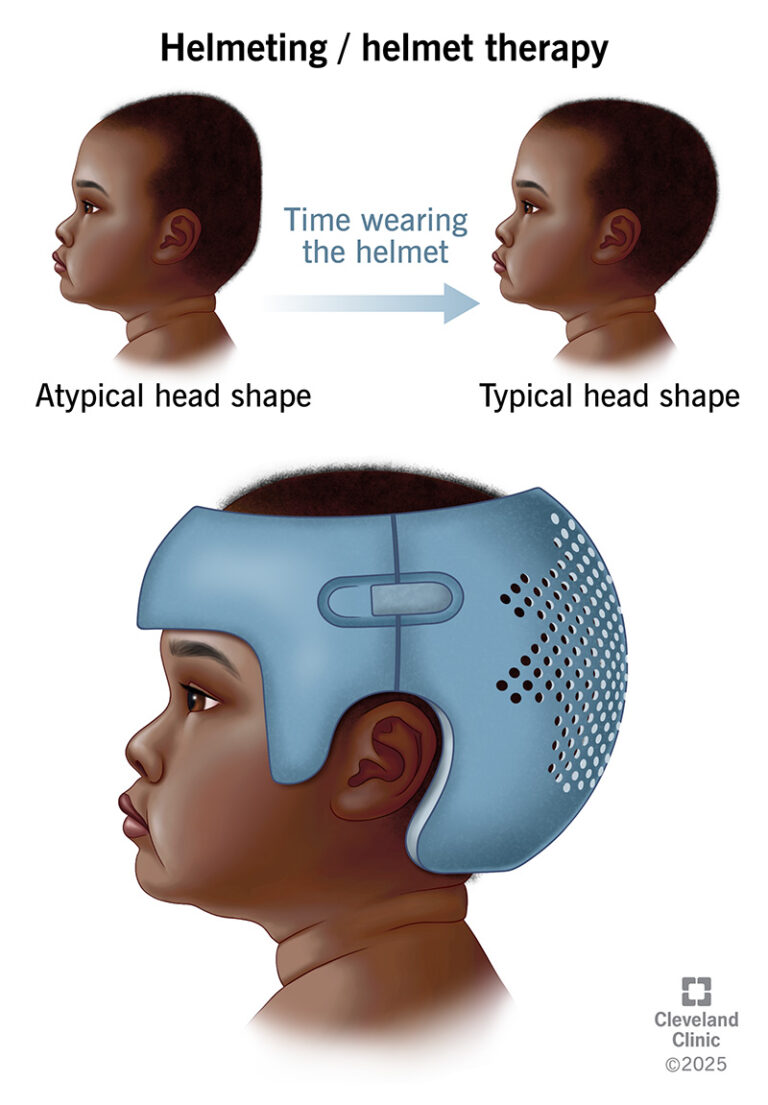
Head shape and posture often affect each other. Some babies develop a flat area on the back or side of the head, known as positional plagiocephaly. This can happen when a baby rests with the head in one position for long periods.
Back sleeping remains the safest sleep position. Parents should not use unsafe sleep products to prevent flat spots.
During awake time, parents can reduce pressure on one area by:
• Offering supervised tummy time
• Holding the baby more often
• Changing the direction the baby faces in the crib
• Moving toys from one side to the other
• Limiting long periods in car seats and reclined devices
• Asking a clinician about neck stiffness
A baby who always looks one way may have torticollis, a condition involving tight neck muscles. Early assessment can help. Treatment may include gentle exercises taught by a pediatric professional.
Do not stretch a newborn’s neck without guidance. The neck is delicate, and forceful movement can cause harm.
A simple daily plan for healthy posture
Newborn spine and posture development can fit into normal family life. You do not need a strict training program.
Try this simple routine:
-
Begin the day with a few minutes of skin-to-skin holding.
-
Offer short tummy time after a diaper change when the baby is awake.
-
Carry the baby in different safe positions.
-
Give the baby time to move freely on the back.
-
Place toys at the center and then slightly to each side.
-
Change feeding and holding positions when practical.
-
Give the baby a break from seats and swings.
-
Note new skills and share concerns at checkups.
Parents often worry that they are not doing enough. In practice, small moments add up. A few minutes of floor play, a walk while carrying the baby safely, and a calm change of position can all support healthy development.
The goal is not to make the baby sit straight or look like a small adult. The goal is to provide safety, comfort, movement, and time.
When professional support can help
A pediatrician is the best first contact for concerns about newborn spine and posture development. The doctor can decide whether the baby needs monitoring, imaging, or a referral.
A pediatric physical therapist may help with:
• Neck movement
• Head control
• Muscle strength
• Tummy time tolerance
• Rolling and sitting skills
• Uneven movement
• Handling and carrying methods
Early support does not mean a parent has done anything wrong. Babies can have tight muscles, birth-related strain, feeding challenges, or other needs that benefit from guidance.
Parents should also share information about premature birth, difficult delivery, known medical conditions, or a family history of muscle or nerve disorders. These details help clinicians understand the full picture.
Avoid choosing treatment based only on social media testimonials. Spinal manipulation, forceful stretching, and unapproved devices may be unsafe for newborns. The safest plan is one made with a licensed healthcare professional who knows the baby’s health history.
Frequently Asked Questions About Newborn Spine and Posture Development
Is a newborn’s spine supposed to be curved?
Yes. A newborn usually has a rounded C-shaped spine. This shape is normal and changes as the baby gains head control, sits, stands, and walks.
When does a baby’s spine become straighter?
The spine develops new curves over time. The neck curve grows with head control, and the lower back curve becomes clearer as the child stands and walks.
Can tummy time hurt a newborn’s spine?
Supervised tummy time on a firm surface is safe for most healthy babies and supports muscle growth. It should only happen when the baby is awake, and the baby should sleep on the back.
Should I worry if my baby arches the back?
Occasional arching can happen during stretching, crying, feeding, or movement. Frequent, forceful arching, pain, poor feeding, vomiting, or poor weight gain should be discussed with a pediatrician.
Is it safe to sit a newborn upright?
A newborn may be held upright with full head and neck support. However, parents should not prop the baby into sitting for long periods or force the baby into a position the baby cannot hold.
How often should a newborn do tummy time?
Many experts suggest starting with three to five minutes two or three times each day and building slowly. Several short sessions are useful if the baby tires or fusses quickly.
Can baby carriers affect spine development?
A properly fitted carrier can support normal carrying and bonding. The baby’s face must stay visible, the airway must remain clear, and the hips and back should be supported without forcing the legs straight.
When should I call a doctor about posture?
Call the pediatrician if the baby is very stiff, very floppy, strongly favors one side, cannot turn the head both ways, loses a skill, or seems to have pain. Urgent care is needed for breathing trouble, severe weakness, or movement loss after an injury.
Conclusion
Newborn spine and posture development is a slow, natural process. A rounded back, bent limbs, and limited head control are usually expected in the early weeks. Safe sleep, supervised tummy time, free floor movement, gentle handling, and regular checkups give the spine and muscles the support they need.
Watch the baby’s progress over time rather than comparing one posture or milestone with another. If movement looks uneven, painful, or delayed, ask a pediatrician early. Use this guide as a starting point, explore trusted pediatric resources, and share your questions with your child’s healthcare team.